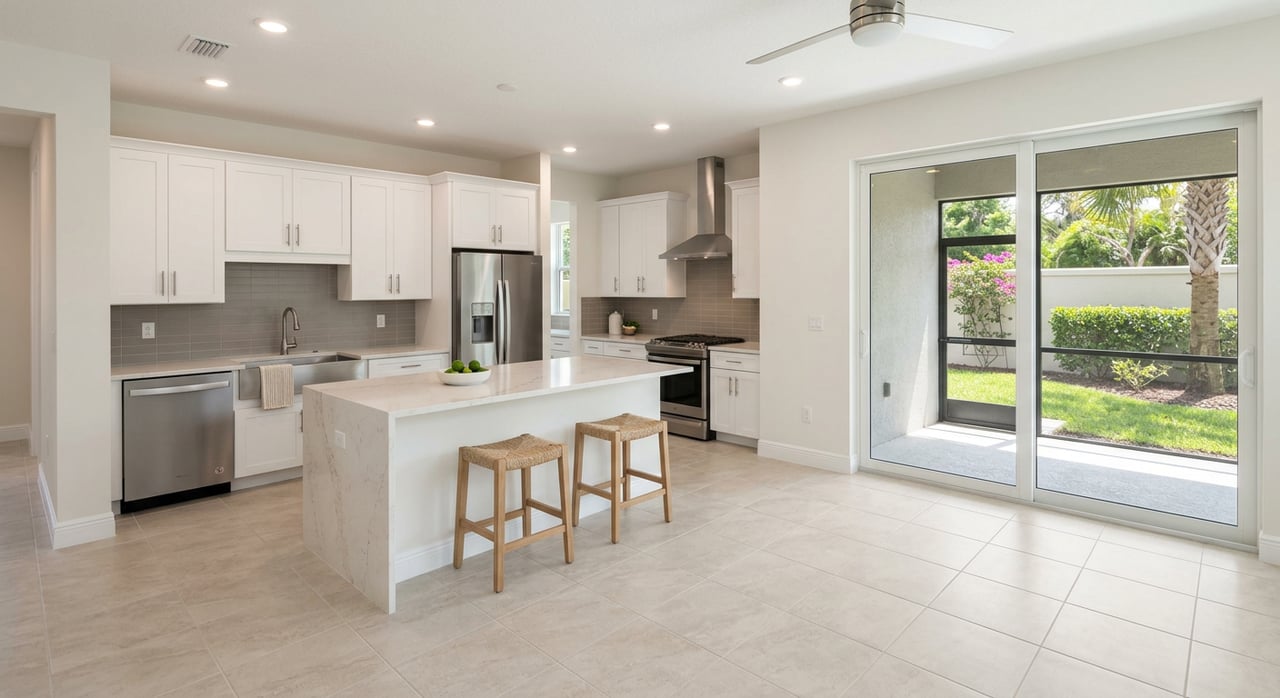
Should you buy a brand-new home or a resale in Estero? It is a big decision, and the right choice depends on your timing, budget, and how much customization you want. You might love the idea of new systems under warranty, or you may prefer the charm and mature landscaping you find in established neighborhoods. In this guide, you will compare both paths using local context so you can make a confident move in Estero. Let’s dive in.
Estero market snapshot
If you are pricing options, remember that citywide figures vary by data source and timing. A February 2026 Redfin snapshot reported a median sale price around $425,000 and about $252 per square foot for Estero, with roughly 80 days on market. Other aggregators often publish higher medians because they mix in different property types and time windows. The key takeaway is that price per square foot ranges widely across communities, especially between mass-market production homes and luxury gated enclaves.
New construction: what to expect
Builders and communities
You will find active production and national builders in and around Estero, including Lennar, Pulte, Taylor Morrison, and Neal Communities. Large master-planned developments by Cameratta Companies, such as Verdana Village, bring multiple builders and amenity sets under one umbrella. For context on scale and builder mix, review the developer’s announcement for Verdana Village, which outlines a 2,400-home vision and participating builders in Estero’s corridor in this project overview.
Timelines and move-in options
Build timing depends on the product type and lot. Production homes and quick-move-in inventory can be ready in months, while semi-custom or custom builds take longer. National-level analysis shows single-family construction speeding up in recent years as supply chains improved, with permit-to-completion times often in the 8 to 9 month range for built-for-sale homes. Use this as a benchmark and confirm local schedules with your builder, since custom designs, permits, and upgrades can extend timelines. For broader context, see this industry timing analysis on single-family construction speeds.
Warranties and service
Most new homes come with layered protection, commonly a 1-year workmanship warranty, 2-year coverage on major systems, and a longer structural warranty often up to 10 years. Many regional and national builders follow this 1-2-10 pattern and use a dedicated customer-care team or third-party administrator to handle claims. Ask for the builder’s warranty booklet and service process before you sign, and schedule your 11-month walkthrough to capture items within the warranty window. For an example of how this coverage is structured, review the Neal Communities warranty overview.
HOA, CDD and monthly costs
New master-planned communities frequently include homeowners association dues and, in some cases, a Community Development District that helps fund infrastructure. CDD assessments typically appear on your property tax bill, while HOA dues are paid monthly or quarterly and vary by amenities. Always request current budgets, covenants, and any start-up or capital assessments if the neighborhood is still building out. You can look up special district details through Lee County’s registry of special districts, including CDDs and confirm community-specific information with the developer. Some large communities have their own district sites as well, such as Miromar’s CDD resource pages.
Financing and incentives
If you select a completed spec or quick-move-in home, you will likely use a standard mortgage. Custom or semi-custom builds often require construction-to-permanent financing or a two-step construction loan with draws tied to build milestones. Builders may also offer incentives like rate buydowns or closing-cost credits through preferred lenders. Talk with a lender early to understand draw schedules, inspections, and builder approval requirements. This construction loan guide explains how draws and inspections typically work.
Resale homes: what to expect
Advantages you feel right away
With a resale, you can move on a faster schedule and often enjoy mature landscaping, established streetscapes, and a settled neighborhood identity. You will see more variety in architecture and lot sizes across Estero’s established communities. If you prefer to renovate on your terms, a resale can be a smart way to buy into a neighborhood you love and update finishes over time.
Risks and smart due diligence
Older roofs, HVAC systems, or windows can mean near-term expenses, so budget using a thorough inspection and seller disclosures. Florida now requires a separate flood disclosure form, known as FD-1, to be provided to buyers at or before contract execution. Make sure you receive it and review the property’s flood history and zone details. You should also request HOA documents, recent meeting minutes, and financials for communities with shared amenities. For a clear overview of the state’s flood disclosure requirements, read Florida’s FD-1 flood disclosure guidance.
Price per square foot by area
Townwide averages hover in the mid $200s per square foot depending on the data feed and period. Luxury enclaves command more. Recent neighborhood snapshots show Miromar Lakes tracking around the mid $400s per square foot, reflecting waterfront and club amenities. Production communities like The Place at Corkscrew and similar developments typically sit between mass-market resale and top-tier luxury, with price per square foot influenced by floor plan, lot, and upgrades.
New vs. resale: quick comparison
Timeline
- New construction: weeks for a quick-move-in to many months for semi-custom or custom. Recent industry averages for built-for-sale homes often fall near 8 to 9 months from permit to completion. See the broader context on construction speeds.
- Resale: immediate occupancy after a standard escrow.
Up-front price vs. long-term cost
- New construction: can carry a higher list price per square foot, but you gain modern codes, energy efficiency, and warranty coverage.
- Resale: may offer a lower initial price per square foot, though you should budget for near-term capital items like roofs, HVAC, and windows.
Warranty and repairs
- New construction: layered builder warranty support is common. See the 1-2-10 pattern example.
- Resale: no builder warranty, but you can negotiate repairs or credits and consider an optional home-warranty plan.
Customization
- New construction: design-center selections let you personalize finishes and options. Ask for inclusions lists and change-order policies in writing.
- Resale: you renovate after closing. Updates can sometimes cost less than comparable builder markups, but plan for timelines and permits.
HOA, CDD, and amenities
- New construction: master-planned communities often include robust amenities, HOA dues, and potential CDD assessments. Confirm all recurring costs with the developer and consult the county’s special districts registry.
- Resale: dues vary by neighborhood and amenity level. Review budgets, reserves, and any planned assessments.
Insurance and resilience
- New construction: modern codes and resilience features can reduce storm vulnerability and may influence insurance pricing. The Insurance Institute for Business & Home Safety offers research on how stronger standards reduce losses; see their year in review for a broader perspective.
- Resale: condition, age of systems, and flood zone will drive quotes. Ask your agent and insurance professional for estimates early.
Financing complexity
- New construction: custom builds may require construction loans with draws and inspections. Learn the basics in this construction loan process guide.
- Resale: typically financed with a standard mortgage.
How to decide in Estero: a simple plan
Follow this step-by-step approach to compare both paths with clarity.
- Define your timeline and non-negotiables
- Decide if you need to move within 30 to 90 days or can wait several months.
- List must-have features like bedroom count, home office space, or a three-car garage.
- Compare total monthly carrying costs
- Request HOA dues and amenity fees for each community you tour.
- Ask if a CDD applies and how it appears on your tax bill. Use Lee County’s special districts resource to confirm.
- Price the true cost of ownership
- New construction: get the inclusions list, upgrade catalogue with estimates, and the builder’s written change-order policy.
- Resale: schedule a professional inspection, review seller disclosures, and collect contractor quotes for any near-term items.
- Verify risk and insurance early
- Request the FD-1 flood disclosure for resales and ask the builder about elevation and code compliance for new homes. Review Florida’s FD-1 overview.
- Contact an insurance professional for preliminary quotes for both scenarios.
- Clarify build timelines and warranties
- Ask the builder for a milestone schedule with target and contingency dates. Confirm deposit, delay, and cancellation terms in writing.
- Review the warranty booklet and service process. See a typical structure in the Neal Communities warranty summary.
- Align financing with your choice
- If custom-building, discuss one-time-close or two-step construction loans and draw inspections. Start with a lender’s construction loan guide.
- If you want quick occupancy, target quick-move-in homes or resales that fit your mortgage preapproval.
Ready to explore Estero?
Both new construction and resale homes can be great fits in Estero. If you want modern systems, tailored finishes, and layered warranty coverage, new construction delivers peace of mind with a longer runway. If you value mature neighborhoods and faster move-ins, a resale may offer the right mix of price, character, and convenience. When you are ready to compare specific communities, tour model homes, or evaluate inspection findings, connect with Jason Armstead for boutique, neighborhood-first guidance across Estero and the greater Southwest Florida corridor.
FAQs
What is the typical new-home build time in Estero?
- Build times vary by product and lot, but national benchmarks show many built-for-sale homes completing in roughly 8 to 9 months from permit to finish; confirm your builder’s local schedule and contingency windows.
How do HOAs and CDDs affect my monthly budget in Estero?
- HOAs charge monthly or quarterly dues for amenities and maintenance, while CDD assessments, if present, appear on your property tax bill; request current budgets and confirm details through the county’s special district resources.
What warranties do new homes usually include?
- Many builders offer a layered 1-year workmanship, 2-year systems, and up-to-10-year structural warranty; ask for the warranty booklet and service process before you sign.
What is Florida’s FD-1 flood disclosure for resales?
- FD-1 is a required flood disclosure sellers must provide at or before contract execution; it outlines known flood history and helps you evaluate risk and insurance needs.
How do prices per square foot vary across Estero communities?
- Townwide averages often sit in the mid $200s per square foot, while luxury enclaves like Miromar Lakes can trend in the mid $400s per square foot; production communities typically fall between those ranges depending on plan, lot, and finishes.